

Share This Article
About the author
Shweta Jha enjoys exploring social issues, women’s experiences and the stories that deserve a wider conversation. Through research and thoughtful writing, she contributes to women’s magazines’ editorial pages, bringing fresh perspectives to subjects that shape women’s lives and the world around them.
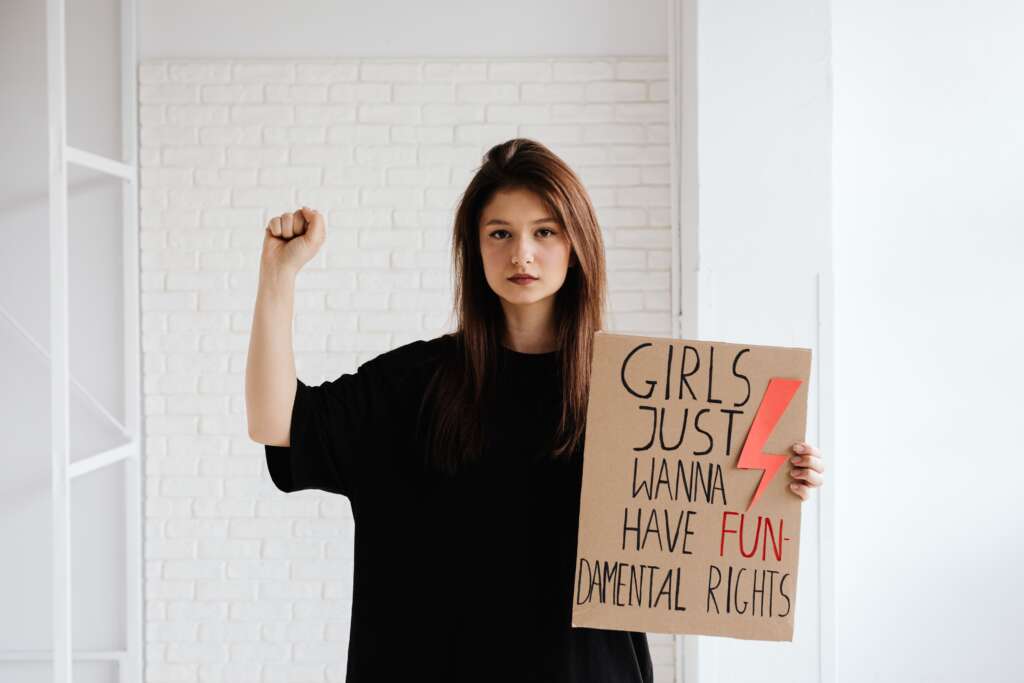
After a series of sexual violence cases in Delhi prompted students to take to the streets, the debate around women’s safety has returned to a familiar question: why are women still expected to limit their freedom to feel safe?
Their demands went beyond the investigation into one case. Students questioned why women were being advised to avoid certain places, restrict their movements after dark or take additional precautions, instead of seeing greater efforts to make those places safer. The message carried by one of the marches was simple: Hum Auratein Azaad Hain, meaning: we, the women, are free.
It is difficult to ignore the contradiction. A public park is meant to be a place people can visit. A university is meant to open doors. A street is meant to connect one place to another. Yet for many women, using these spaces comes with a calculation that men are less likely to have to make.
Which route is safest? Is there enough light? How late is too late? Should I take a cab instead? Will someone stay on the phone with me until I get home? These are not unusual questions in the lives of women. That is precisely what makes them troubling.
The outrage following the Delhi incident is understandable. But once the immediate anger subsides, we are left with a larger question: why does a woman’s freedom to occupy public space still seem conditional on her ability to protect herself from the possibility of violence?
A freedom that comes with conditions
Most women grow up learning a familiar set of rules. Do not stay out too late. Avoid deserted roads. Keep your phone charged. Share your location. Be careful about what you wear. Let someone know when you reach home. Much of this advice comes from people who genuinely care. Parents worry about their daughters. Friends check whether one another have reached home safely. Women develop routines to make travelling alone feel less uncertain. There is nothing wrong with taking precautions. The problem begins when precautions become the price of ordinary freedom.
A man returning home after dinner may simply think about how long the journey will take. A woman making the same journey may consider the lighting on the road, the availability of transport, who is around her and whether she should call someone until she reaches home. The destination may be the same. The experience of getting there may not be.
This difference affects more than evening walks or late-night outings. A woman may turn down a job because the commute is difficult, leave a social gathering early, avoid a park where she would otherwise exercise or hesitate to travel to an unfamiliar city alone.
Over time, these decisions can become so routine that they no longer look like restrictions. They are simply described as being sensible. But it is worth asking why being sensible so often requires women to make their lives smaller.
When safety becomes a woman’s responsibility
One of the most frustrating aspects of conversations about women’s safety is how quickly they turn into discussions about women’s behaviour.
Was she out too late? Was she alone? Was the place deserted? Why did she take that route? Could she have been more careful? These questions may be presented as practical concerns, but they can shift attention away from the person responsible for the violence and towards the person who experienced it.
The same pattern appears in everyday life. If a road is unsafe, women are told to avoid it. If public transport feels uncomfortable, they are advised to take a cab. If an area has a history of harassment, families may restrict their daughters from going there. Sometimes, these precautions are necessary in the short term. But they cannot be the whole answer.
In the aftermath of the Delhi incident, students challenged restrictions on women’s movements and called instead for better lighting, safer transport and greater accountability. Their concern points to an important distinction: preventing women from entering an unsafe space is not the same as making that space safe.
If a college is concerned about its students’ safety, it should be able to take immediate protective measures. But those measures should be accompanied by efforts to address the underlying problem. If women are discouraged from using a park after dark, there should also be questions about its lighting, security, accessibility and maintenance. Otherwise, the burden of an unsafe environment quietly falls on the people whose freedom is already being restricted.
A woman should not have to demonstrate that she followed every precaution before her experience of violence is taken seriously. Nor should she be expected to surrender her independence because someone else may choose to harm her.
The cost of feeling unsafe
The effects of unsafe public spaces are not always visible. They do not necessarily appear in police reports or make headlines. Sometimes, they show up in the opportunities women decide not to pursue.
Consider a young woman who receives an internship offer but discovers that the journey home involves a long walk from the nearest bus stop. Another may want to attend an evening lecture but have no reliable transport home. A working professional may be perfectly qualified for a role that requires late shifts, yet hesitate because getting home safely is uncertain. None of these women has necessarily been directly threatened. Nevertheless, the possibility of harassment can influence the choices available to them.
There is an economic dimension to this problem as well. Women who choose private cabs over public transport may incur additional expenses. Those who leave work early may lose opportunities for professional development. Those who cannot travel independently may become more dependent on family members or others for access to education, employment and social life.
The International Labour Organization’s research on unpaid care and domestic work has shown how responsibilities outside paid employment already shape women’s participation in the workforce. The World Bank’s Women, Business and the Law project examines the legal and institutional conditions that influence women’s economic opportunities. These studies address different aspects of inequality, but both are relevant to a wider discussion about the conditions women need to participate fully in society. Safety is one such condition.
A woman may have the qualifications, ambition and ability to pursue an opportunity. But if the journey to that opportunity is unsafe, expensive or difficult to manage, her practical freedom is diminished. This is why women’s safety cannot be treated only as a law-and-order issue. It also affects access to education, work, public life and independence.
The city itself matters
When we talk about public safety, we often focus on policing and individual precautions. Both matter, but the design and maintenance of public spaces deserve equal attention. A poorly lit road, an isolated bus stop, an inaccessible public toilet or an unreliable transport connection can make an ordinary journey considerably more difficult.
Good infrastructure cannot prevent every crime. Nor can installing cameras guarantee that a public space will be safe. But planning that takes women’s experiences seriously can help make spaces more accessible and reduce avoidable risks.
UN-Habitat’s work on gender-responsive urban planning examines how cities can better account for the needs and experiences of women in the design and use of urban spaces. In practical terms, this means asking questions that should be part of urban planning from the beginning. Are footpaths usable? Are streets and public transport connections adequately lit? Can people get home after evening shifts? Are public toilets accessible and maintained? Are there effective ways to report harassment and seek help? These questions are not glamorous. They rarely attract the same attention as a major criminal case. Yet they influence the everyday experience of moving through a city.
Safety also needs to be considered beyond metropolitan areas. Women in smaller towns and rural communities may face long journeys to educational institutions, healthcare facilities and workplaces, often with fewer transport options. The particular barriers differ, but the underlying concern remains: a person’s access to opportunity should not depend on whether they can find someone else to accompany them.
A city cannot claim to be accessible to everyone simply because everyone is legally allowed to enter its public spaces. It must also consider whether people can use those spaces in practice.
Protection should not mean confinement
There is a difficult balance here. Families worry about their daughters’ safety and institutions have a responsibility to protect the people in their care. It would be unreasonable to suggest that all precautions are unnecessary or that every safety concern can be resolved immediately.
But good intentions do not automatically make every restriction fair. When the response to an unsafe environment is to impose curfews, discourage women from travelling alone or limit their access to public places, it is worth asking who bears the cost of that decision.
If women are the ones losing opportunities, changing their routines and giving up independence, while the unsafe conditions remain unchanged, protection risks becoming another form of restriction. There is a difference between helping someone make an informed decision about their safety and deciding that they should not be allowed to make that decision at all.
Women should be able to take precautions without being made responsible for preventing every possible act of violence. Families should be able to care about safety without having to choose between protecting their daughters and supporting their independence.
The aim should be to make it easier for women to participate in public life, not to make their participation conditional on increasingly restrictive rules.
What would a meaningful response look like?
There is no single measure that can make every street, park or transport system safe. But a meaningful response requires more than public outrage after an incident.
- First, public authorities need to identify and address unsafe locations through better lighting, maintenance, accessible transport and appropriate security measures. Safety audits around educational institutions, parks and public transport routes can help identify specific gaps.
- Second, complaints of harassment and violence must be handled seriously. Reporting should be accessible, investigations should be conducted properly, and survivors should receive appropriate support. Surveillance technology may assist in some settings, but it cannot replace effective policing, accountability or functioning complaint mechanisms.
- Third, institutions should review policies that restrict women’s movement in the name of safety. Where temporary precautions are necessary, they should be accompanied by clear efforts to address the risks that prompted them.
- Finally, the conversation needs to begin much earlier than the point at which a crime occurs. Education about consent, boundaries and respect should not be limited to telling girls how to protect themselves. It must also address the behaviour that causes harm and the attitudes that allow harassment to be dismissed or normalised.
Women should also have a meaningful role in decisions about the spaces they use. Their experiences can help authorities identify problems that might otherwise be overlooked, from an isolated stretch of road to transport services that become unreliable after a certain hour.
These measures will not solve every problem overnight. But they move the conversation towards prevention, responsibility and practical change rather than placing the entire burden on individual women.
The right to be there
The protests in Delhi were about justice for a survivor and demands for safer public spaces. They also brought attention to a question that extends far beyond one city or one incident. What does freedom mean if a woman must constantly calculate the risks of exercising it?
It is difficult to speak about equality while women are routinely expected to plan their lives around the possibility of harassment. A right that can be exercised only after careful negotiation with one’s family, one’s surroundings and one’s own fear does not always feel like a complete freedom.
Women should be able to study, work, travel, exercise and spend time with friends without their presence in public spaces becoming a matter of debate. They should be able to return home late without being treated as though the hour itself makes them responsible for what might happen to them.
This does not mean that precautions have no place. It means that precautions should not be mistaken for a solution, and that a woman’s freedom should not be measured by how successfully she avoids danger.
The protests have made the demand clear: women want safety, but they also want the freedom to move, participate and live without unnecessary restrictions. Those demands belong together.
A public park should not become a place women are told to avoid indefinitely. A street should not be treated as belonging more naturally to men. And a woman should not have to explain why she was there before anyone asks why she was harmed. Public spaces belong to the public. Making them safe is a shared responsibility of authorities, institutions and society. The question is not whether women should be allowed to occupy these spaces. They already have that right. The question is whether we are prepared to make that right meaningful.
Women should not have to choose between safety and freedom. Both should be part of the same ordinary life.
- Public Spaces Are Not for Women? The Question India Still Hasn’t Answered
- Feminism, Reconsidered: Somewhere Between What It Was and What It Has Become
- Good Girl Syndrome: Why Women Are Praised for Adjusting and How to Begin Choosing for Yourself
- The Power of Words: How Language Shapes the Way We See Women
- The People Pleasing Trap: How ‘Being Nice’ Can Be Self-Betrayal